
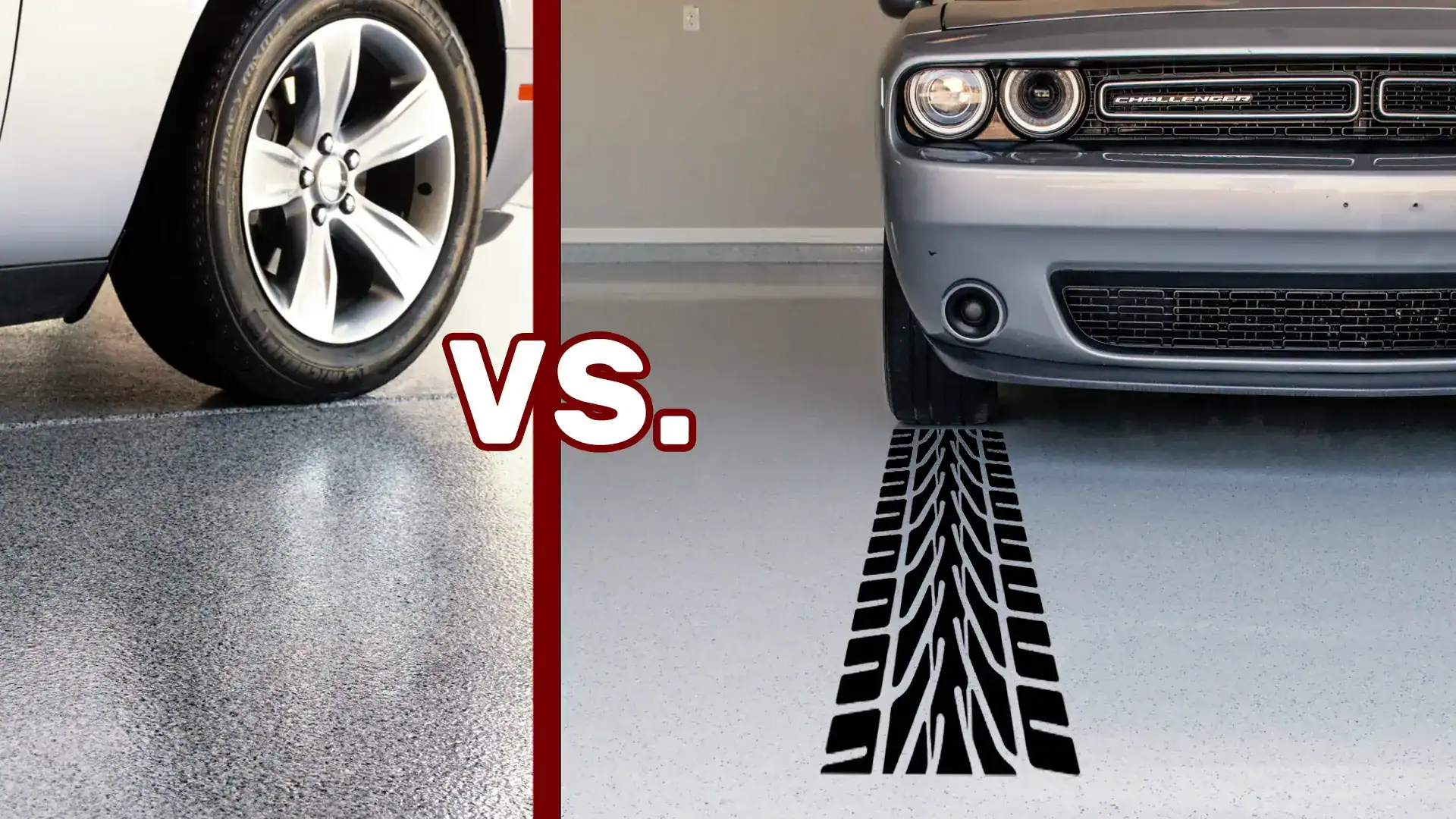
Hot tire transfer is one of the most misunderstood causes of garage floor coating failure. Many homeowners assume all coatings perform the same, until tire marks, discoloration, or peeling start to appear. The truth is, not all polyaspartic floor coatings are built to handle what your tires bring into the garage.
Myth: Hot Tire Transfer Only Happens with Extreme Heat
It is easy to assume this is only a problem on the hottest days. In reality, it happens far more often.
Try this. Feel your tires before you drive to work or run errands. Then feel them once you arrive. Even a short drive will have warmed the surface significantly from friction against the road.
Car tires contain plasticizers that keep the rubber flexible. As tires heat up during driving, these softening agents migrate to the tire’s surface. Once parked, the plasticizers can transfer into the concrete below, leaving behind tread marks and discoloration. If there’s an existing (lesser quality) concrete coating, it may even begin to peel.
Myth: All Polyaspartic Floor Coatings Prevent Hot Tire Transfer
All polyurea-polyaspartic coatings are not created equal! Many 1-day garage floor coatings use polyurea-polyaspartic products that (a) do not provide dense cross-linking, and (b) are less than 100%-solids. Yet in these systems, the thin polyurea-polyaspartic coatings are applied both as the direct-to-concrete primer coat (bad idea in itself!) and single clear topcoat. It’s the final clear top coat that protects the coating system from hot-tire transfer. And lower quality (often 1:1 ratio Part A-Part B ), <100%%-solids polyaspartics are far more susceptible to hot tire transfer and other failures.
And it shows up in the fine print. Some companies will not warranty hot tire transfer at all, recommending vehicle pads instead! That raises an obvious question. Why install a garage floor coating at all if you still have to protect it from your car?
Reality: System Design Determines Performance
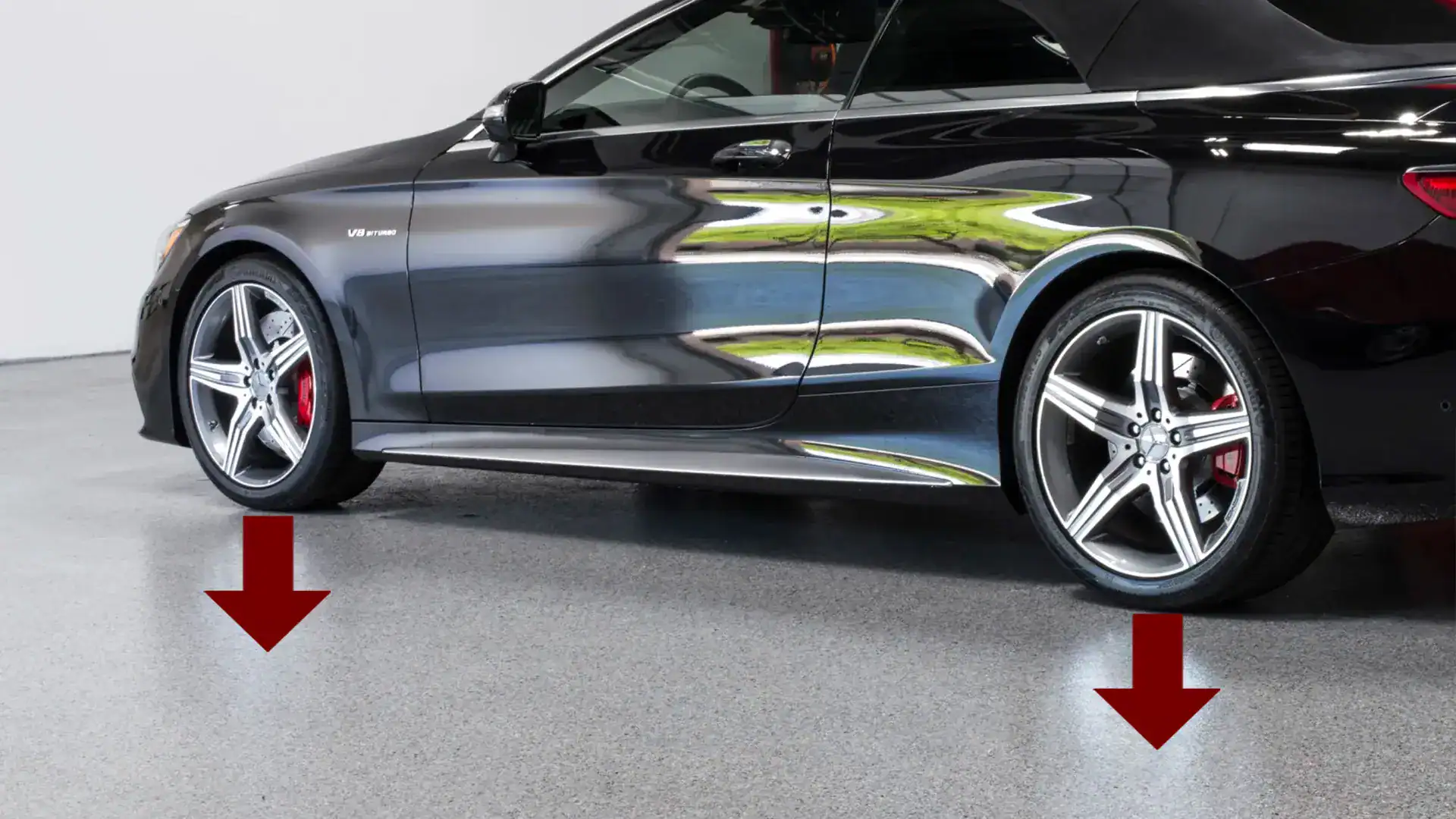
At Garage Floor Coating Western Colorado, we install hybrid epoxy and polyaspartic coating systems over 2 days. We don’t promise a “1-day” install (that’s a good thing) and we only use quality, 100%-solids products. (Check our Technical Data Sheets vs your other bids).
Day one begins with mechanical grinding to properly prepare the concrete. Then, a high-build (read “thick”), moisture-mitigating, 100%-solids epoxy base coat is applied as the moisture vapor barrier. It slowly and deeply penetrates the concrete pores. We then broadcast your chosen full flake blend into this base layer for added strength and texture and let the epoxy base layer cure overnight.
We return on Day two to apply, not one, but two separate (highly cross-linked, 3:2 ratio) 100%-solids clear polyaspartic top coats. The dual topcoats create a dense, UV-stable surface that resists heat, pressure, chemical exposure…and hot-tire transfer.
Reality: The Right Polyaspartic Floor Coating Stops the Problem
A properly installed polyaspartic floor coating prevents hot tire pickup, resists staining, and maintains its appearance over time.
In Western Colorado, where temperature swings and sun exposure are part of daily life, that level of protection matters.
Contact Garage Floor Coating Western Colorado today to learn more about a polyaspartic floor coating system that eliminates hot tire transfer from the start.